
EPA ENERGY STAR's step-by-step guide to running a three-day employee Energy Treasure Hunt that finds low- and no-cost operational savings; partner examples include $12 million found at five Merck plants and $218,000 at one Intertape site.
Public-domain work of the U.S. Environmental Protection Agency (ENERGY STAR), reproduced in full. Original guide: ENERGY STAR Treasure Hunt Guide: Simple Steps to Finding Energy Savings.
U.S. Environmental Protection Agency
Energy Treasure Hunt Guide: Simple Steps to Finding Energy Savings
January 2014
Document Number 430-R-14-001
Foreword
ENERGY STAR® is a voluntary program of the U.S. Environmental Protection Agency (EPA) that helps businesses and individuals save money and protect our climate through superior energy efficiency. For organizations that own or manage commercial, institutional, and industrial facilities, ENERGY STAR resources support strategic energy management through a wide range of tools and strategies that assist companies build such programs and learn best practices through the informative partnership.
Energy Treasure Hunts are one best practice that many ENERGY STAR partner organizations have adopted to identify no- and low-cost savings opportunities and build stronger energy teams. Visit www.energystar.gov/buildings to find more energy management best practices, tools, and partnership information.
Cover photo courtesy of CalPortland Company.
United States Environmental Protection Agency, Office of Atmospheric Programs, Washington DC, 2014. Document Number 430-R-14-001
Opportunities to Save Energy, Save Money
Organizations use resources including labor, materials, equipment, and energy to operate facilities. Most understand the basics of energy use and demand for utilities: electricity, natural gas, compressed air, steam, chilled water, and water. However, many do not regularly consider opportunities for optimizing these resources and controlling operating costs.
The Energy Treasure Hunt is a dynamic, effective process for identifying savings opportunities. By focusing on energy savings, Energy Treasure Hunts support implementation of an energy management program and key components of EPA's ENERGY STAR Guidelines for Energy Management, available online at www.energystar.gov.
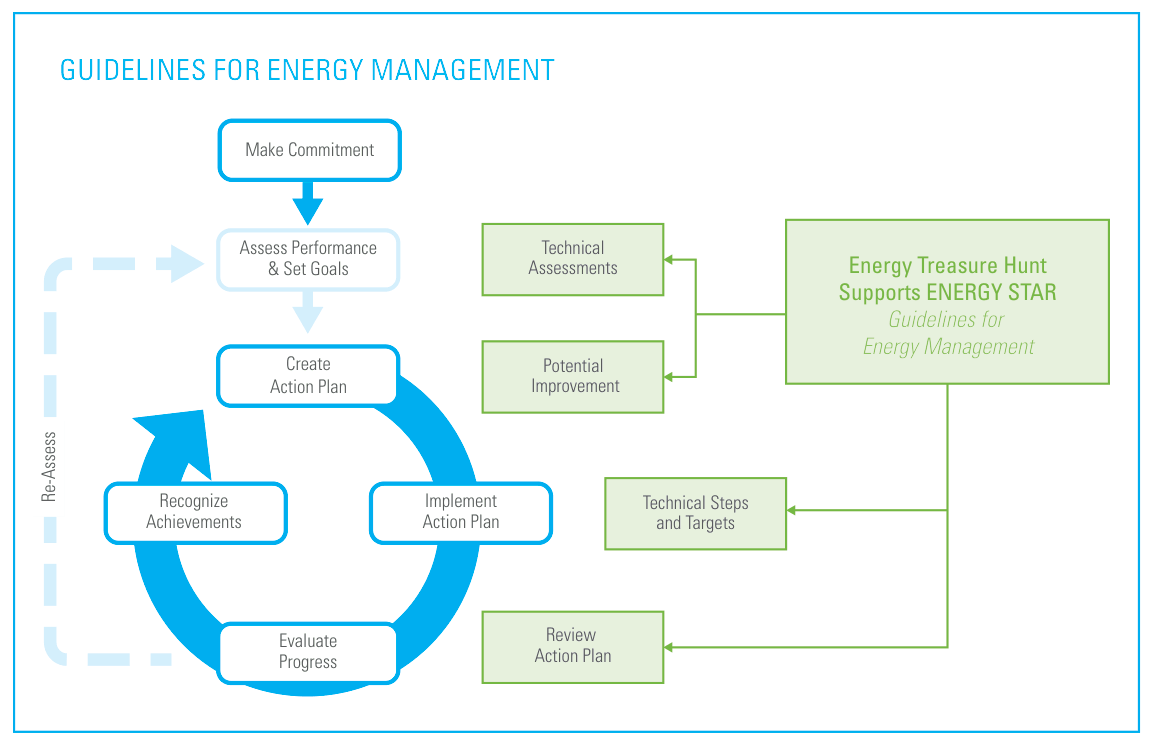
This Energy Treasure Hunt Guide from the EPA presents a step-by-step approach that organizations can follow to integrate Energy Treasure Hunts into a successful energy management program. The activities, forms, and reporting devices described within this guide are designed to help an organization or facility carry out a successful Energy Treasure Hunt. Organizations are encouraged to customize these materials to meet unique energy management needs.
Find Savings Opportunities
The core of an Energy Treasure Hunt is an onsite three-day event in which cross-functional teams of employees identify day-to-day operational energy efficiency improvements. Treasure Hunts also enable employees to build a culture of continuous improvement for implementing energy control measures that reduce use, costs, and associated greenhouse gas emissions.
An Energy Treasure Hunt covers energy management opportunities during both operational and non-operational times. So for organizations that operate Monday through Friday, an Energy Treasure Hunt is best conducted Sunday through Tuesday. For facilities that operate around the clock, an Energy Treasure Hunt can be carried out during any three consecutive days.
Low-Cost Efficiency
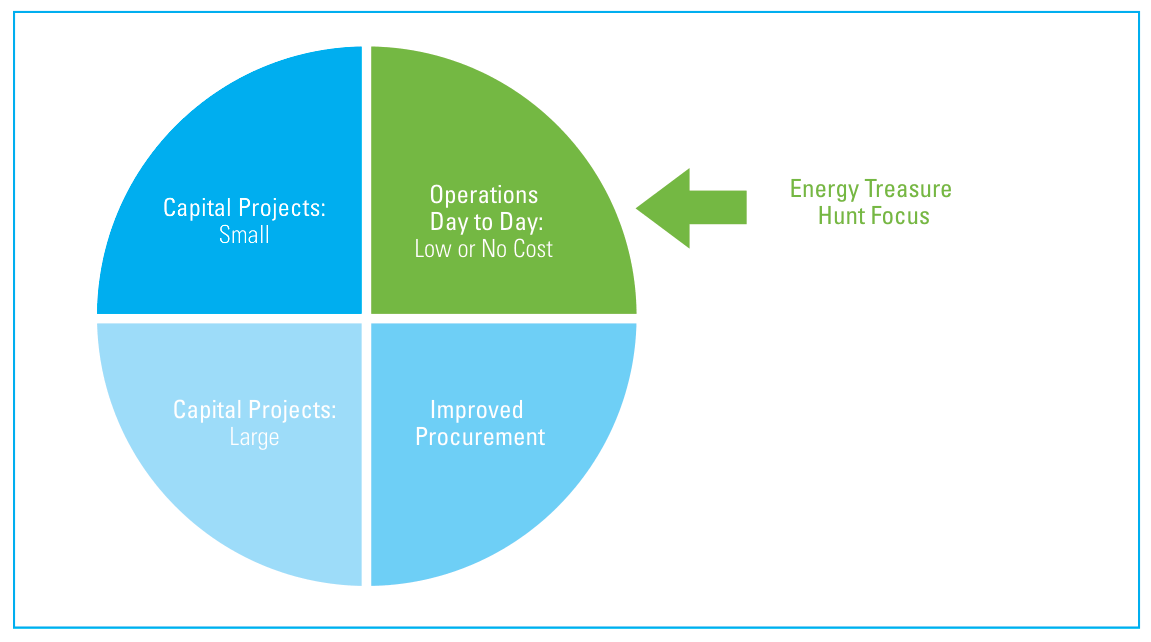
Opportunities for energy efficiency improvement and energy savings typically can be found in four areas:
- Operational – such as eliminating unnecessary use of existing equipment.
- Small capital projects – such as lighting upgrades.
- Large capital projects – such as building renovations.
- Procurement – such as renegotiating utility supply contracts.
An Energy Treasure Hunt focuses on operational opportunities, many of which will be low-cost or no-cost efficiency improvements.
An Energy Treasure Hunt addresses several key questions:
- Where, how, and how much energy is used by the organization?
- How can energy use be reduced?
- How can energy be used more efficiently?
Examining Energy Use: A Unique Approach
An Energy Treasure Hunt differs from an energy audit and an energy assessment, both common practices in energy management.
Energy audits take an in-depth look at an entire facility, focusing on equipment modifications that require capital expenditures. Energy assessments focus on specific energy-using systems in the facility. Both energy audits and energy assessments emphasize capital improvements rather than operational procedures.
All three approaches are relevant and important to enhancing energy performance, but the advantage of starting with an Energy Treasure Hunt is that it focuses on improvements that often can be made immediately and without significant expenditures. Also, Energy Treasure Hunts examine energy use during non-operating hours, when most energy waste occurs.
An Energy Treasure Hunt sets a unique tone for evaluating energy performance by focusing on positive outcomes and improving the day-to-day operations of existing equipment. On the other hand, energy audits and energy assessments often are seen by employees as evaluations intended to pinpoint problems and identify poor performers.
| Energy Treasure Hunt | Energy Audit | Energy Assessment | |
|---|---|---|---|
| Focus Area | Plant or building | Plant or building | Systems |
| Employee Engagement | Yes | Minimal | Yes |
| Resources External to Company or Facility | Yes | Yes | Yes |
| Operational Improvements | Yes | Minimal | Minimal |
| Capital Improvements | Minimal | Yes | Yes |
| Two-way Learning | Yes | Minimal | Yes |
| Summary Report | Yes | Yes | Yes |
| Cross-functional Focus | Yes | Minimal | Minimal |
Continuous Improvement
Organizations and facilities of any type can carry out Energy Treasure Hunts. The size of an organization or facility is not an indicator of a Treasure Hunt's success. Both small and medium-sized organizations can gain the same benefits as large organizations.
Beyond the three-day event, Energy Treasure Hunts support continuous improvement in four important ways:
- Optimization: Improving the operation and efficiency of existing equipment before considering equipment replacement. This is not only cost effective, but also prompts employees to consistently think of the most efficient management practices.
- Teamwork: Engaging and educating employees to identify opportunities to reduce energy use and make energy program enhancements.
- Ownership: Involving employees to help create a sense of responsibility for the solutions.
- Repetition: Conducting an Energy Treasure Hunt two or more times per year produces the strongest benefits.
Compelling Benefits of the Treasure Hunt
- Develops employees' energy knowledge.
- Motivates employees to pursue energy innovation.
- Creates focus on low-cost operational improvements.
- Establishes culture of continuous improvement and cross-functional collaboration.
- Reduces overall energy use, energy costs, and greenhouse gas emissions.
- Requires lower initial coordination cost compared to an audit or assessment.
- Sparks employee ownership of energy-saving strategies.
Four Phases Focused on Results
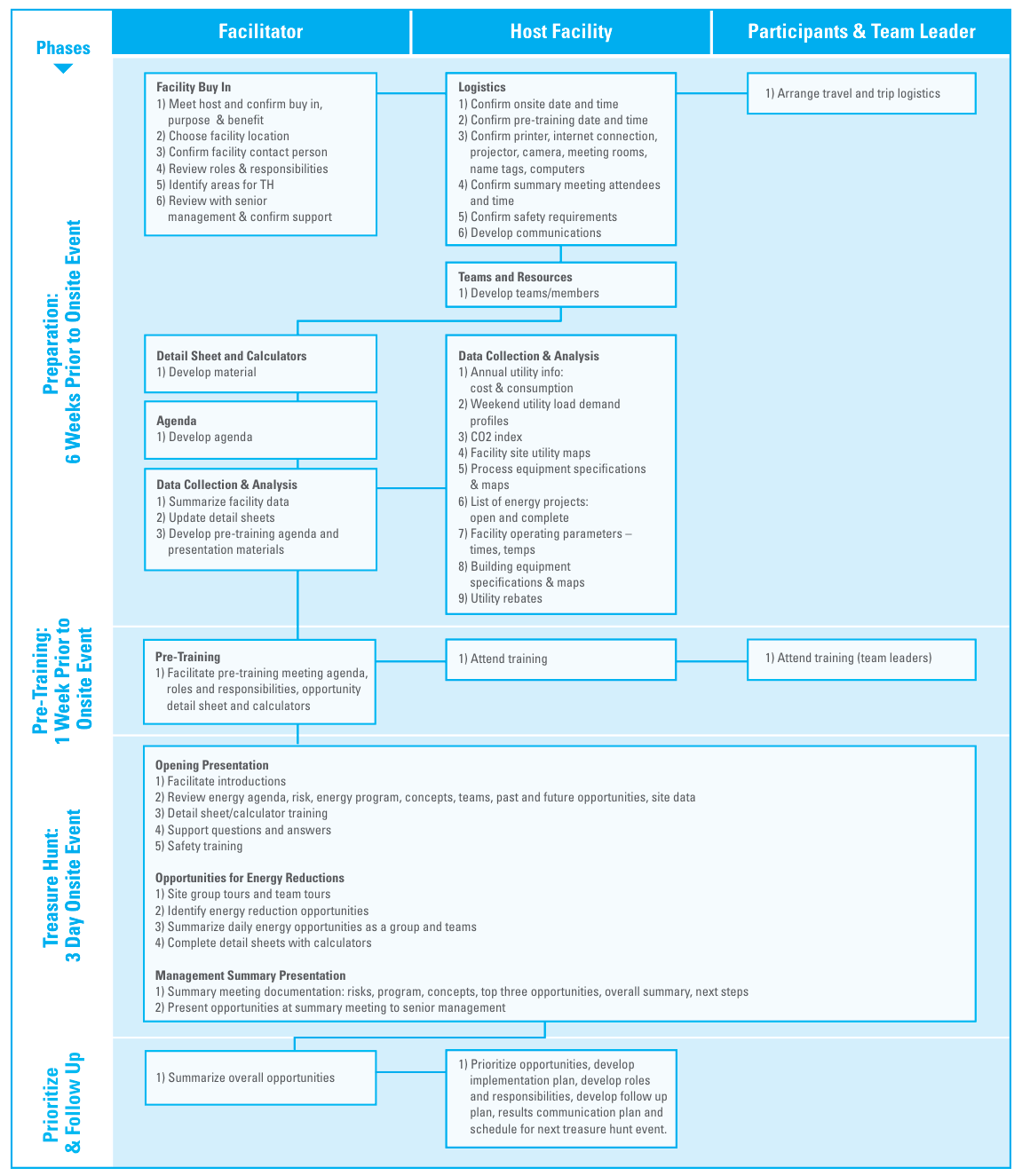
A comprehensive Energy Treasure Hunt has four distinct phases:
- Preparation: Schedule discussions with your organization's or facility's leadership to obtain their support. Gather data on current energy usage and costs, equipment specifications, and operating parameters. Begin this phase at least six weeks before the planned onsite event.
- Pre-Training: Meet with facility team leaders to confirm roles and responsibilities and Energy Treasure Hunt agenda. Pre-training should begin at least one week before the onsite event.
- Three-day Onsite Event: Teams identify and quantify energy-saving opportunities at an onsite three-day event. Summarize and present the results for management review.
- Follow-up: Develop a schedule for pursuing the energy reduction opportunities identified during the Energy Treasure Hunt. This should be completed one to four weeks after the onsite event.
The four phases of the Energy Treasure Hunt, with defined roles and responsibilities of the various participants, are illustrated in Figure 3.
Phase 1: Preparation
Thorough planning and communication before an Energy Treasure Hunt are vital to ensuring it is carried out efficiently and productively. Phase 1 is carried out well in advance of the Treasure Hunt. Phase 1 consists of these main activities.
- Gaining facility buy-in
- Coordinating logistics
- Creating Treasure Hunt agenda
- Assembling teams and resources
- Collecting and analyzing data
- Developing opportunity detail sheets
- Selecting energy calculators
Gain Facility Buy-in
Meet with senior management of the organization or facility to discuss the purpose, benefits, and process for the Energy Treasure Hunt and obtain their agreement, support and participation in the process. Be sure to explain how the Energy Treasure Hunt will not only contribute to energy cost savings and greenhouse gas reduction, but also will enhance workforce engagement and ownership. Your discussion with management also should cover the resources, time, and support from the facility that will be required before, during, and after the onsite event. Management should commit to attend the summary presentation during the onsite event, where they will be asked to provide direction for implementing low-cost and no-cost improvements.
| Activity | Tasks |
|---|---|
| Meet Leaders and Secure Buy-in | Meet with senior management representatives and review the Energy Treasure Hunt concept, purpose, and benefits, and obtain buy-in. |
| Choose Location | Identify which facility (or facilities) will host an Energy Treasure Hunt. |
| Select Host Facility Contact Person | Identify the individual at the host facility who will coordinate the Energy Treasure Hunt and be the facility representative. |
| Review Roles and Responsibilities | Discuss the roles and responsibilities for all phases of the Energy Treasure Hunt, the timeline, and overall expectations. |
| Specify Scope | Determine whether the entire facility, or only specific areas, will be involved in the Energy Treasure Hunt. |
| Confirm Management Support | Confirm that the facility's senior management supports execution of the Energy Treasure Hunt and will provide input and guidance on the recommendations presented. |
Coordinate Logistics
To ensure the Energy Treasure Hunt runs smoothly, develop a schedule and plan to have the appropriate resources on hand in advance to support the participants.
| Activity | Tasks |
|---|---|
| Confirm Onsite Event Dates and Times | The Energy Treasure Hunt should examine both operational and non-operational periods, if possible. Sunday through Tuesday works well for many organizations, but you can select any three consecutive days if the facility operates continuously. |
| Confirm Pre-Training Date and Time | Schedule a discussion with team leaders to review the Energy Treasure Hunt agenda as well as roles and responsibilities. |
| Confirm Facility and Technology Resources | Check availability and policies for using meeting rooms, network hookups, flipcharts, projectors, cameras, computers, name tags, and other equipment Energy Treasure Hunt participants will need. |
| Confirm Summary Meeting Date, Time, and Attendees | Schedule the summary meeting to occur during the third day of the onsite event. Confirm which members of the organization and facility leadership will attend the meeting. |
| Review Safety Requirements | Read and plan to implement the facility's policies for required personal protective equipment. |
| Communicate Event Details | Send invitations to all participants and leadership; provide means for them to confirm attendance and ask questions. Develop and execute a facility communication strategy to ensure all personnel are aware of the planned Energy Treasure Hunt. Inform facility personnel that they might be asked to provide input to the Energy Treasure Hunt team. |
Create an Agenda
To optimize Energy Treasure Hunt outcomes over the three-day period, you should prepare a detailed agenda that covers both operational and non-operational times, if possible. Facility down time often generates different sights and sounds that can help the Energy Treasure Hunt team identify energy reduction opportunities.
| Day | Activity | Function | Location |
|---|---|---|---|
| Sunday | Treasure Hunt Summary | Energy journey, Energy Treasure Hunt introduction, possible opportunities and detail sheet demonstration | Host Facility |
| Observe Non-Operational Mode | Identify ideas during non-operational mode | ||
| Create Detail Sheets | Enter opportunity into detail sheet | ||
| Summarize Findings | Teams/group summarize findings | ||
| Monday | Observe Startup | Identify equipment starting too early | Host Facility |
| Observe Operations | Identify operational energy opportunities | ||
| Observe Lunch Break | Identify equipment to turn off during lunch (between shift if applicable) | ||
| Create Detail Sheets | Enter opportunity into detail sheet | ||
| Summarize Findings | Teams/group summarize findings and pick top 3 | ||
| Tuesday | Finish Detail Sheets | Complete detail sheets for remaining opportunities and refine top 3 opportunities | Host Facility |
| Finalize Summary Presentation | Summarize total opportunities and practice presentation | ||
| Summary Presentation | Highlight top 3 opportunities and next steps |
Assemble Teams and Resources
Energy Treasure Hunt teams should include facility staff or corporate staff who represent relevant cross-functional areas. Teams should be composed both vertically (to engage all perspectives, from executive management to production line staff) and horizontally (to increase engagement in the energy management program and ensure diversity of skills, including equipment operation, maintenance, engineering, production, and procurement). Vertically and horizontally composed teams bring a variety of experience and perspectives to identifying ways to reduce energy use, learning from each other, and securing broad buy-in of Energy Treasure Hunt findings.
Conducting a successful Energy Treasure Hunt relies on the staff fulfilling essential roles:
- Facilitator: Coordinates and manages all phases of the Energy Treasure Hunt.
- Qualifications: Thorough energy management technical and program knowledge, plus meeting coordination and facilitation skills.
- Host Facility Contact Person: Main point of contact at the facility where the Energy Treasure Hunt will be conducted.
- Qualifications: Thorough knowledge of the day-to-day technical operations of the facility, the facility's organizational structure, and the ability to resolve organizational difficulties that arise.
- Team Leaders: Coordinate Energy Treasure Hunt team participants.
- Qualifications: Good working knowledge of the facility's day-to-day operations and meeting facilitation skills.
- Participants: Join the team from the host facility, other company facilities, or other companies; utility company representatives; or product manufacturing representatives.
- Qualifications: Good working knowledge of the facility's day-to-day operations in production, maintenance, engineering, and/or energy procurement.
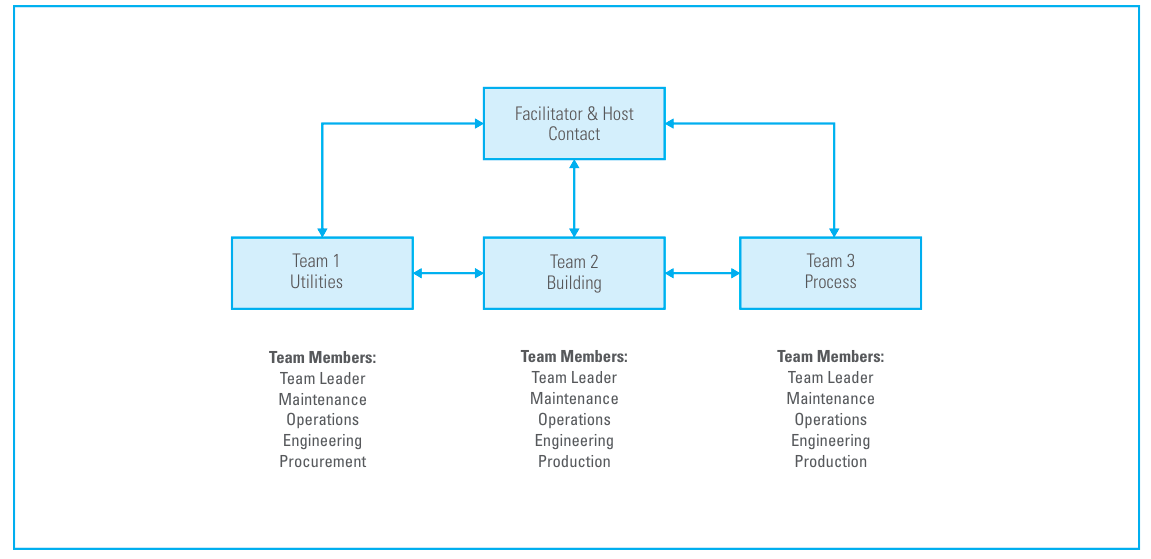
Energy Treasure Hunts typically have three technical teams made up of three or four members per team, with one additional member assigned as the team leader. The number of teams you assemble will depend on the size and scope of the Energy Treasure Hunt area. Three teams of three or four members typically are effective for a facility of 300,000 to 1 million square feet.
One team might focus on the facility's utility equipment, while another team examines the building equipment, and a third team analyzes the process equipment. These cross-functional teams should have representatives from maintenance, engineering, procurement, production, other company facilities, corporate staff, and external organizations such as utility companies or equipment suppliers.
| Activity | Tasks |
|---|---|
| Confirm Facilitator | Identify the person who will be the facilitator for the event. |
| Establish Technical Teams | Determine specific topics or facility areas for each technical team. |
| Identify and Confirm Team Leaders | Nominate and select a leader for each technical team. |
| Identify and Confirm Participants | Nominate and select technical team participants and confirm their assignments. |
Collect and Analyze Data
The Energy Treasure Hunt facilitator and host facility contact person should work together to gather relevant data and analyze it before the three-day event. This advance work reduces the administrative burden and provides consistency during the event.
| Data Categories | Tasks |
|---|---|
| Annual Utility Costs and Consumption | Gather last year's (or most recent 12 months') annual energy consumption and cost data for all utilities used by the facility. Confirm energy cost per energy unit for all sources. Confirm annual energy reduction targets. |
| Weekend Utility Load Demand Profiles | Compile weekend demand profiles for all utilities for a typical summer and winter, either from onsite metering systems or through utility company metering systems. |
| CO2e Emission Factors | Gather information related to the CO2e emission factors for electricity and fuels. The utility companies should be a source for this information, or use www.epa.gov/climatechange. |
| Site Utility Maps | Gather the facility one-line diagrams for all the utility systems. This may include electrical, natural gas, steam, compressed air, chilled water, water and other utility systems. Include a building outline map of the facility. |
| Process Equipment Specifications and Maps | Gather the specifications for the major users of energy for the process systems, including horsepower, equipment size, and operating hours. |
| Energy Project Lists | Compile a list of current or proposed energy projects for the facility, as well as those implemented during the past 12 months. |
| Facility Operating Parameters | Create a list of facility operating parameters such as operating hours, shifts, and set points for major equipment. |
| Building Equipment Specifications and Maps | Gather the specifications for the major users of energy for the building systems, including horsepower, equipment size, and operating hours. |
| Utility Rebates | Collect information on available local, state, or federal incentives and rebates for future energy projects. The website www.dsireusa.org is a good resource. Gather details on current utility rate structures. |
Develop Opportunity Detail Sheets
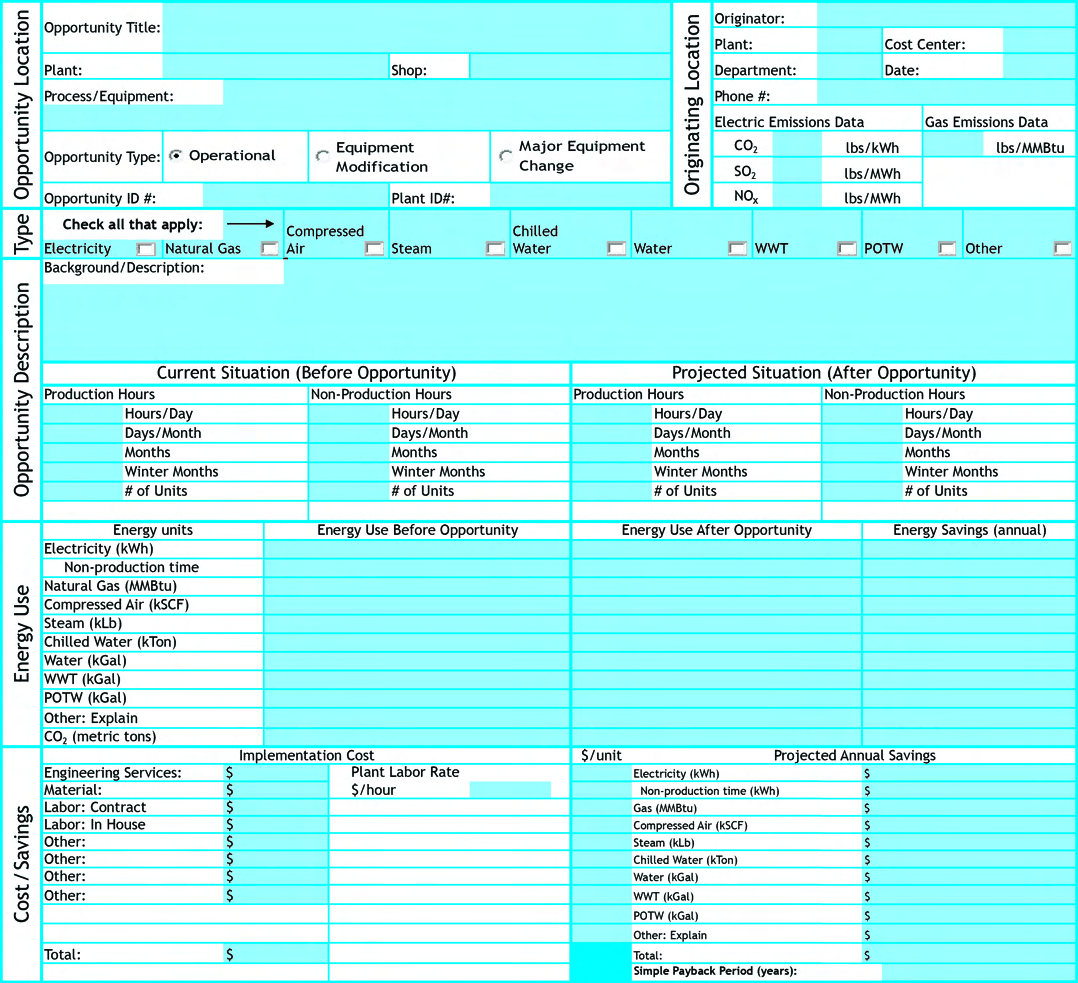
Detail sheets are forms used to systematically capture and summarize the specifics of a potential energy-saving measure. Detail sheets provide a standard format for quantifying the energy cost and consumption reduction opportunities identified during the Energy Treasure Hunt. Each opportunity pinpointed during the Energy Treasure Hunt will have its own detail sheet. Detail sheets are used to create the summary report.
Detail sheet format and the methodology for tracking energy opportunities should be discussed and agreed upon before the Energy Treasure Hunt is conducted. Detail sheets often cover the following:
- Background Information – Location, Resource, and Description
- Short description of the energy opportunity, including project title, location, equipment affected, name of person completing the detail sheet, and date.
- Type of opportunity: operational, small capital, larger capital, other.
- Type of energy resource to be saved: electricity, natural gas, compressed air, steam, other.
- Description of the current situation and the proposed situation. For example, how the system currently operates and the changes that could be made in set points or operating parameters to improve efficiency.
- Current and proposed equipment operating time, such as hours per day, days per month, or months per year.
- Analysis – Energy Use and Cost Savings
- Annual energy consumption based on the current operation, annual energy consumption after proposed change, and annual energy consumption savings based on the difference.
- Annual greenhouse gas savings based on the difference in energy consumption.
- Overall installation cost, including labor and material, to implement the opportunity.
- Annual energy cost based on the current operation, annual energy cost after proposed change, annual energy cost savings based on the difference, and simple payback. Depending on your organization, you might need to include additional financial evaluation metrics.
Select Energy Calculators
To complete the detail sheets, you will need a way to consistently calculate the energy consumption and cost savings associated with the potential measures identified during the Energy Treasure Hunt. An energy calculator uses engineering formulas to calculate the savings for specific energy efficiency measures or projects. The calculator results are put into the detail sheets.
Energy Treasure Hunt calculators use standard engineering formulas to calculate savings, efficiency gains, paybacks, and other important metrics. These formulas can be found in energy management reference manuals or online at www.energystar.gov, www.eere.energy.gov, and www.eia.gov (see Appendix B: Energy Treasure Hunt Calculators). The formulas can then be set up in a spreadsheet. Free calculators are available for many common building and plant systems. In addition, calculators are available commercially from vendors and service providers.
The facilitator should develop or determine the calculators that will be used during the Energy Treasure Hunt. The calculators you need will depend on the types of systems at the host facility that are going to be evaluated. Either through discussions with the host facility contact person or direct knowledge of the site, the facilitator should identify the types of systems for which calculators will be needed. Common systems include lighting, HVAC, motors, compressed air, and chilled water. The facilitator also should work with the facility contact person to obtain current energy rate structures, other relevant cost rates used at the facility (such as labor rates), and any unique factors (such as discount rates) used as part of economic evaluations at the site.
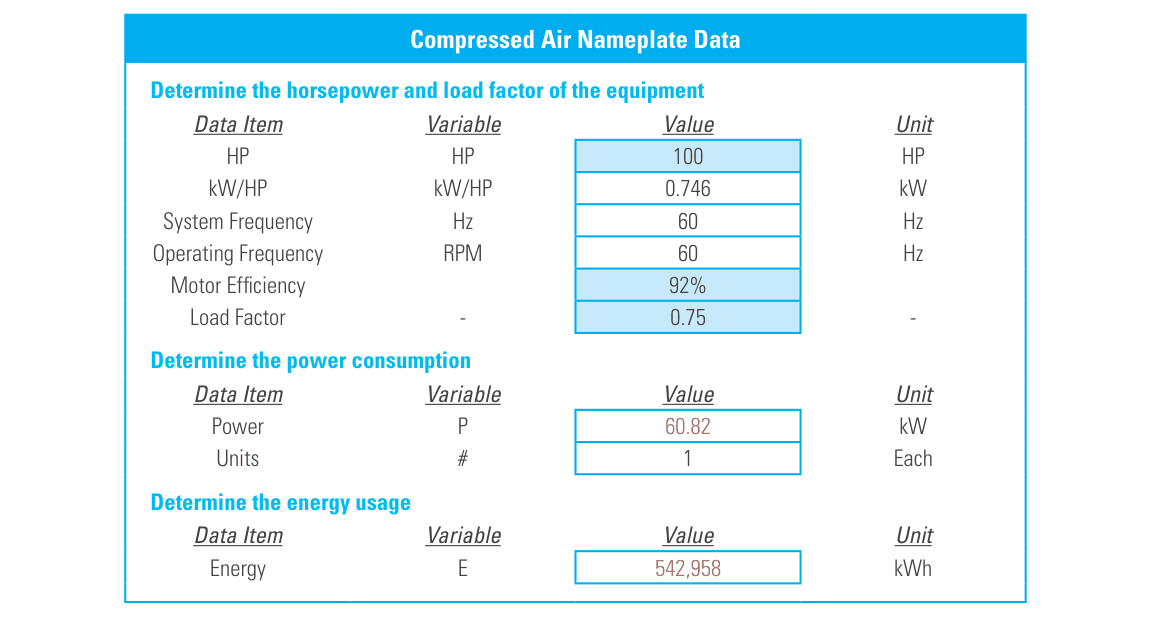
The energy calculator example was used for examining compressed air systems during an Energy Treasure Hunt. In this example, the calculator allows the Energy Treasure Hunt team to easily calculate the energy and cost savings associated with an energy management opportunity: turn off an air compressor on weekends. To create this calculator, the facilitator identified the engineering formulas used to calculate the avoided electrical consumption and costs of not running the air compressor on weekends and built the formulas into an easy-to-use spreadsheet. The outputs of this calculator then became the consumption and cost inputs to the detail sheet. Additional examples of calculators are located in Appendix B.
Developing detail sheets and calculators requires some upfront work by the facilitator or team leaders, but once they are created, they become important tools that can be used for the initial and all subsequent Energy Treasure Hunts.
Phase 2: Pre-Training
During the pre-training phase, the facilitator should review the Energy Treasure Hunt agenda with the host facility contact person and the team leaders. They also should outline specific roles and responsibilities and discuss the format of opportunity detail sheets and energy calculators.
| Activity | Tasks |
|---|---|
| Finalize Agenda | Review the Energy Treasure Hunt agenda and confirm key milestones, such as group review of identified opportunities at the end of each day, method for estimating the associated savings, and plan for reporting the findings. |
| Roles and Responsibilities | Make sure team leaders understand how to leverage team members' skills and knowledge to complete data collection, opportunity identification, calculations, and presentation materials. |
| Review Opportunity Detail Sheets | Explain the process for inputting energy opportunity information into the detail sheets and tracking the results. |
| Review Energy Calculators | Decide on the energy calculators that will be used in the Energy Treasure Hunt. Discuss the process to be followed if new calculators need to be created during the three-day event. |
Phase 3: Three-day Onsite Event
The three-day onsite event is the core activity of the Energy Treasure Hunt. During this time, the technical teams identify possible opportunities for saving energy and saving money, analyze the potential benefits of the measures, develop energy- and cost-saving calculations, calculate potential greenhouse gas savings, summarize the results, and report their findings to the organization or facility management.
Day One
Activity #1: Introductions and Background
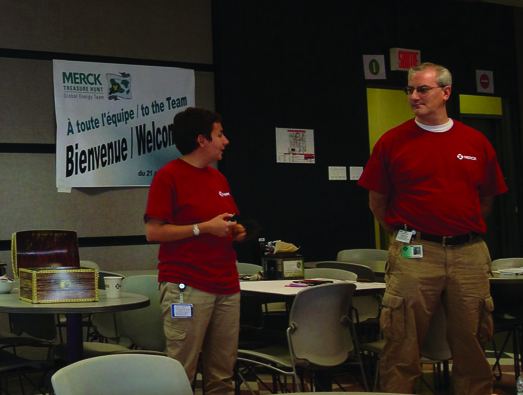
The facilitator should welcome participants and introduce team members. Participants should state their name and position and give a brief summary of their skills. The facilitator then should provide an overview of:
- Energy Treasure Hunt agenda.
- Energy risks of the facility in terms of cost, reliability, and environment.
- Developing an energy program based on the ENERGY STAR Guidelines for Energy Management.
- Key Energy Treasure Hunt concepts, including purpose, benefits, and contribution to continuous improvement.
- Energy Treasure Hunt teams and participants.
- Annual energy consumption and cost by utility, with cost breakdown by utility system.
- Examples of energy management opportunities identified during previous Energy Treasure Hunts at the same facility or elsewhere.
- Completed or proposed energy management opportunities at the facility from the previous year, if available.
- Brainstorming for potential technical opportunities such as utility supply and building systems, process equipment, and maintenance and operations. Cite examples such as air compressor header pressure reduction, turning off lighting, or reducing boiler start-up time, etc.
- Completing opportunity detail sheets and detail sheet calculation examples.
| Opportunity Item | Implementation Idea |
|---|---|
| 1) Process air leak reduction | Eliminate leaks |
| 2) Control cabinet compressed air blowers | Turn off or use electric fans |
| 3) Conveyor lines on | Interface to process line |
| 4) Interior lighting | Replace with energy efficient bulbs and motion sensors |
| 5) Exterior lighting | Replace with energy efficient bulbs and photo cells |
| 6) Air compressor | Heat recovery of exhaust air |
| 7) Air compressor header pressure | Reduce set point |
| 8) Equipment operation | Turn off on weekends |
| 9) Water reduction | Interface water to process line |
| 10) Oven temperatures | Reduce set point during non-production or downtime |
| 11) Compressed air leak program | Develop program to repair air leaks |
| 12) Restroom water | Install water efficient nozzles |
| 13) Plant process lighting | Turn off when not needed |
| 14) Equipment operation | Develop standardized work sheets |
| 15) Air compressor operation on weekends | Turn off |
| 16) Boiler controls | Reset with outside air, VFDs, stage with load |
| 17) HVAC economizers | Repair and confirm operation and use |
| 18) Vending machines | Install misers to turn off when not needed |
| 19) Office equipment | Turn off when not needed or use sleep mode |
| 20) Oven heat recovery | Recover heat as input supply |
| 21) Heating and cooling | Reset heating/cooling set points based on outside temp |
| 22) Oven operation | Reduce set points and operate oven with production |
| 23) Steam header set points | Reduce for summer and winter set points |
| 24) Air compressor controls | Operate in energy efficiency mode |
| 25) Steam traps | Develop maintenance program |
| 26) Demand control | Duty cycle equipment when peak demand |
| 27) Burner control | Calibrate gas trains |
| 28) Interface equipment to production | Turn on and off equipment based on production line |
| 29) Insulate ovens | Add insulation to ovens |
| 30) Oven seals | Repair oven seals on doors |
| 31) Oven operation | Operate ovens based on production profile |
Activity #2: Facility Tour
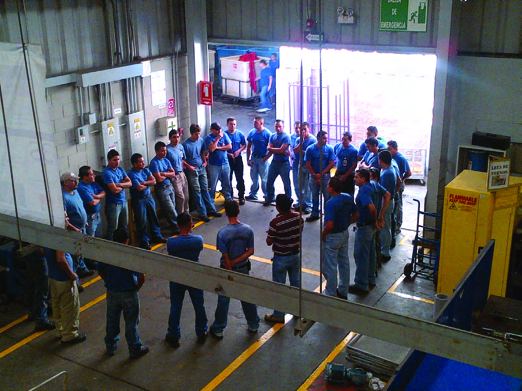
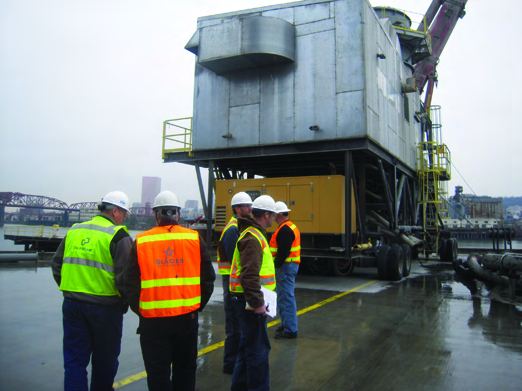
All technical teams should tour the facility together during non-operating hours, if possible. A tour outside of typical business hours gives Energy Treasure Hunt participants a better understanding of the facility and how its equipment functions.
Activity #3: Exploring Ways to Save – Non-Business Hours
After the facility tour, teams should begin to look for energy efficiency opportunities in their respective areas. If the Energy Treasure Hunt begins on a non-operational day, the teams should focus on investigating savings opportunities that can only be found when the facility is not carrying out its typical operations. They might look for:
- Lights, computers, and other equipment that has been left on.
- HVAC systems that have been left running or HVAC operations beyond standard temperature set points.
- Lighting that is too bright, not efficient, or not directed to necessary tasks.
- Air compressors operating when not needed or system air leaks.
- Other building or process equipment left running unnecessarily.
Activity #4: Detail Sheets
After identifying potential opportunities, the team will need to set aside time to calculate potential energy consumption and cost savings. Detail sheets for the specific identified opportunities should then be completed.
Activity #5: Findings and Group Meeting
At the end of day one, each team should present its findings to the entire Energy Treasure Hunt group. This meeting and presentation will ensure everyone understands how and why energy is used in the facility and allow them to apply cross-team knowledge and exchange ideas about potential energy management opportunities.
Day Two
Activity #1: Exploring Ways to Save – Business Hours
On the second day, Energy Treasure Hunt teams can focus on energy efficiency opportunities that are observable during regular operations and in typical equipment processes. These might include:
- Temperature set point too high or too low.
- Compressed air being wasted.
- Energy supply equipment, such as compressed air and lights, not interlocked to turn off at the same time as production equipment.
- Production equipment operating but no product being produced.
During staff lunch and break periods, teams should check the facility for equipment that could be turned off, such as:
- Work space lighting, motors, and pumps that are not in constant use.
- Equipment that does not have a lengthy start time but is left on.
Activity #2: Detail Sheets
Similar to day one, teams should complete opportunity detail sheets to quantify the savings that could be realized by implementing energy reduction measures.
Activity #3: Findings and Group Meeting
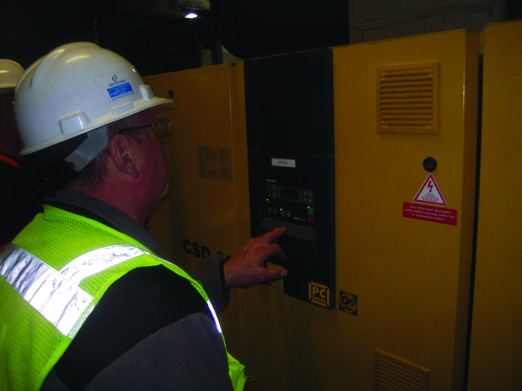
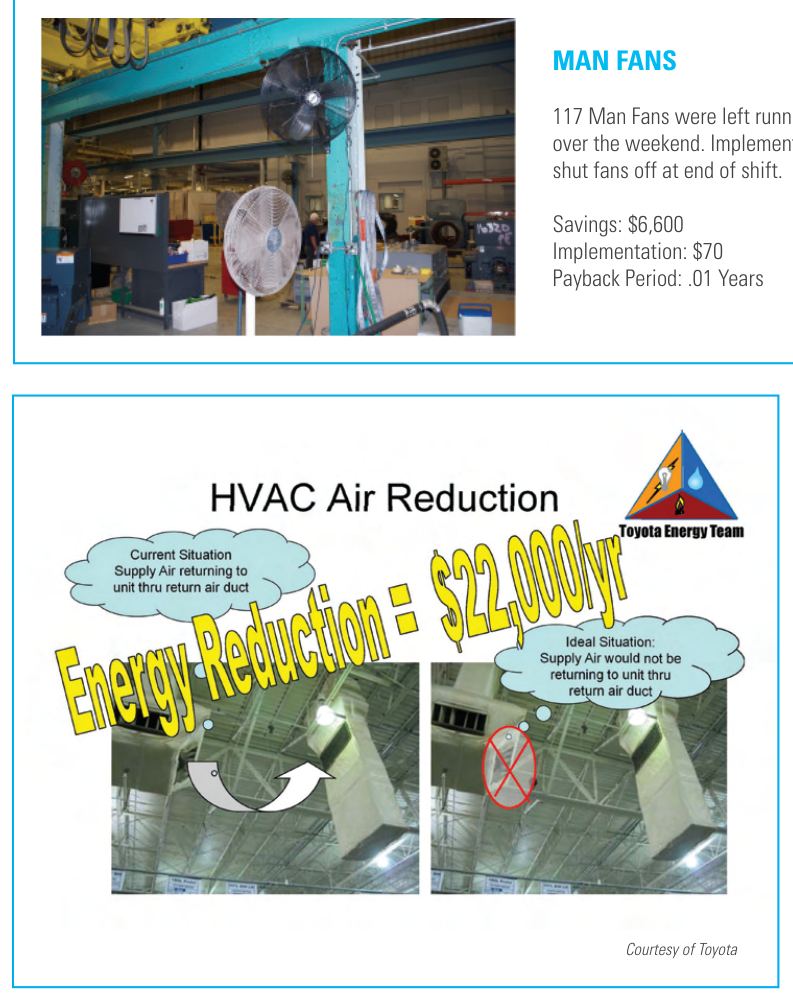
Teams regroup and present their day two findings. The presentations should be followed by discussion of the proposed solutions and determination of which approaches might enhance energy efficiency. The teams should each select the three opportunities that promise the greatest potential for saving energy and money. These three opportunities per team will be addressed in the summary presentation, which will include:
- Comprehensive description of energy management opportunities.
- Completed opportunity detail sheets.
- Photos, slides, graphics, or other visuals that depict the opportunity.
Day Three
Activity #1: Detail Sheets
Teams can identify additional energy management opportunities to be included in the summary presentation and should complete a detail sheet for each opportunity. If the teams have identified additional opportunities but more cost analysis is needed, they should designate those opportunities for further exploration by the organization or facility.
Activity #2: Preparation for Summary
The three-day event concludes with a presentation to organization or facility management, who ultimately will approve which energy efficiency measures are implemented. Management representatives scheduled to attend this presentation should agree to the date, time, and location before the Energy Treasure Hunt three-day event takes place.
The Energy Treasure Hunt team should prepare a comprehensive presentation that summarizes the findings across the three days. The facilitator should schedule adequate time for participants to rehearse delivering the presentation.
Activity #3: Presentation of Findings
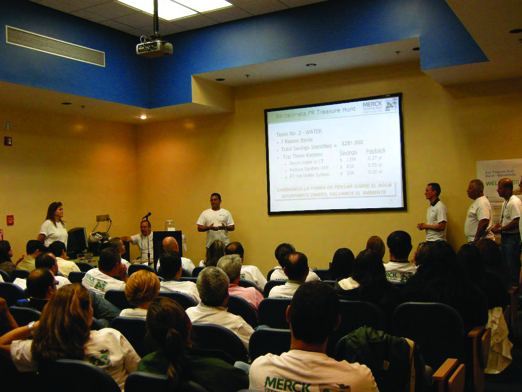
Presentation of the team's findings is perhaps the most important activity in the entire Energy Treasure Hunt process. During the presentation, the Energy Treasure Hunt team builds a case, supported by its calculations, to gain approval to move forward with implementing the energy efficiency measures they identified.
The presentation should begin by discussing the importance of energy management and providing a context for why the Energy Treasure Hunt was conducted. Points to cover include:
- Energy risks: cost (electricity and natural gas price forecasts), reliability (utility supply reliability), and environment (climate change possibilities and proposed regulation).
- Background on the company's energy program, including overall energy cost by energy source and system, energy cost per unit of production and energy reduction targets.
- Key Energy Treasure Hunt concepts: purpose, benefits, value.
The presentation should outline specific details of the Energy Treasure Hunt. Areas to cover include:
- Energy Treasure Hunt teams and their focus areas.
- Top three opportunities identified by each technical team, with photos and details.
- List of all opportunities identified.
- List of additional opportunities that may require large capital expenditures, or opportunities that require more analysis and should be completed later.
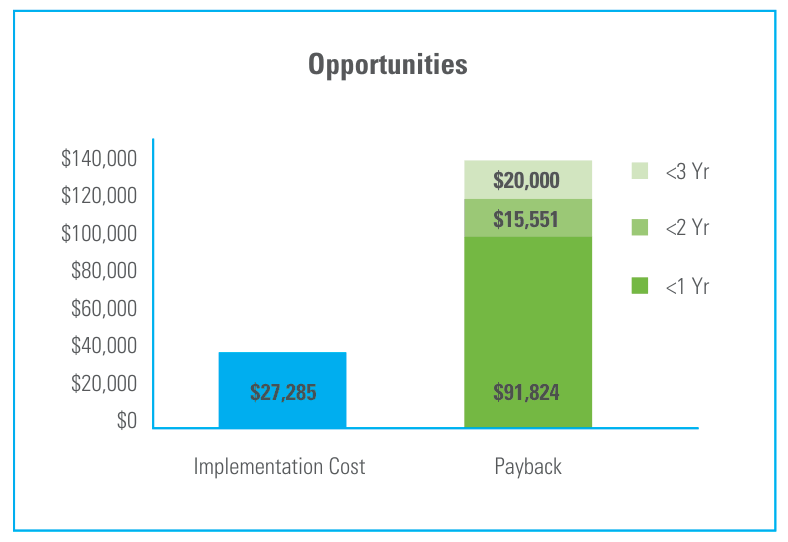
- Cost and payback of each measure.
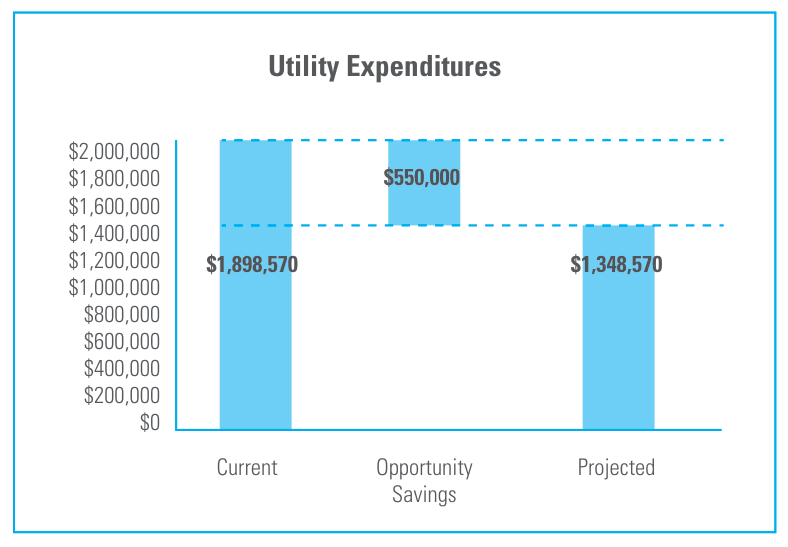
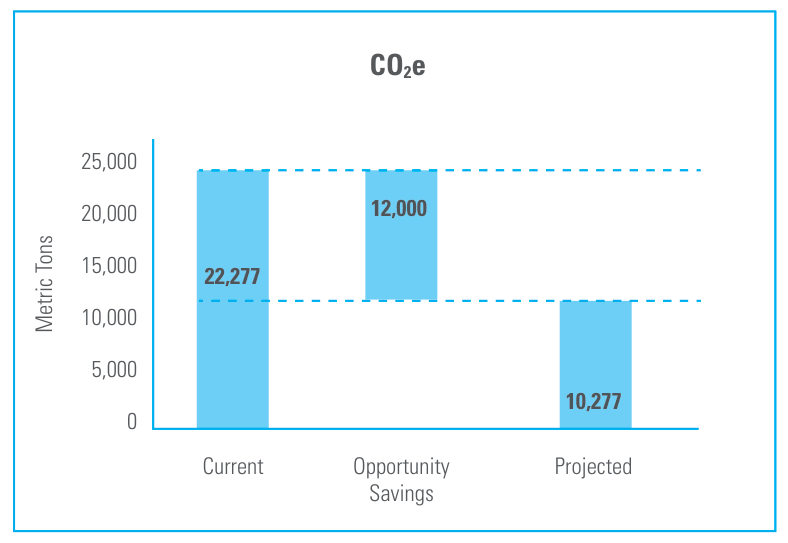
- Energy opportunity summary related to energy savings as a percentage of the facility total energy, energy savings as a percentage of the facility reduction target, energy savings overall payback, and CO2e savings reduction illustrated in terms of homes or vehicles.
- Proposed next steps with implementation responsibilities.
- Summary of requests or approvals needed from organization or facility leadership.
At the conclusion of the meeting, the facilitator should give each decision maker a copy of the Energy Treasure Hunt summary report, including the detail sheets.
Phase 4: Follow-up
Within four weeks after the summary presentation, the Energy Treasure Hunt team, in conjunction with organization or facility management, should finalize a process to prioritize the identified energy management opportunities for implementation. The process should include ways to check the status of energy projects against the implementation schedule and monitor project results.
| Activity | Tasks |
|---|---|
| Prioritize Opportunities | Review all opportunities listed in the summary report and prioritize them in light of payback, ease of implementation, and overall control. |
| Develop an Implementation Strategy | Devise a detailed plan for moving forward with each of the proposed measures. |
| Outline Roles and Responsibilities | Assign individuals to be responsible for all aspects of implementing each measure. |
| Create a Schedule | Attach target completion dates to each measure and determine frequency (weekly, monthly, quarterly) and format for tracking progress. |
| Communicate Outcomes | Develop publications, e-mails, webinars, visual boards or other internal communication outlets to build awareness of the Energy Treasure Hunt findings among all employees. Keep staff up to date on completion of energy efficiency measures and savings generated. |
| Schedule Additional Energy Treasure Hunts | Develop a five-year schedule for Energy Treasure Hunts to support continuous improvement and facilitate planning. Encourage staff to volunteer to participate in upcoming events. |
Planning for Energy Treasure Hunts should be ongoing. Answering the following questions related to the Energy Treasure Hunt just completed will help guide how subsequent Energy Treasure Hunts take shape.
- Have all the opportunities that were identified been scheduled or completed?
- Who coordinated and participated in implementing the energy efficiency measures, and how will they be involved in the next Energy Treasure Hunt?
- Are there areas in the facility that were not covered during the previous Energy Treasure Hunt?
- Who should attend the next Energy Treasure Hunt?
- How can we expand Energy Treasure Hunt engagement and involvement?
Learn More
Energy Treasure Hunts are a valuable component of a strategic energy management program based on the ENERGY STAR Guidelines for Energy Management. Energy managers and others can use Energy Treasure Hunts to identify energy-saving opportunities while building a culture of continuous improvement and establishing an effective and sustainable energy program within their organization.
Energy Treasure Hunts are most influential when they are conducted regularly and are backed by management buy-in, workforce engagement, solid preparation, a well-defined list of energy reduction opportunities, and quick implementation of energy- and money-saving measures.
Providing recognition to sites that achieve savings from implementing strategies identified by the Energy Treasure Hunt is an excellent way to reinforce the importance of energy management and maintain employee engagement. ENERGY STAR offers several different forms of recognition to sites based on their energy performance and savings.
Find more information on US EPA's ENERGY STAR and discover additional ways to build energy efficiency and savings into your business at www.energystar.gov.
Appendix A: Energy Treasure Hunt Checklists
Preparation Checklist (6 Weeks Prior to Onsite Event)
| Categories | Description | Status |
|---|---|---|
| Gain Facility Buy-In | ||
| Meet Leaders and Secure Buy-in | Review purpose and benefits, and obtain buy-in | |
| Choose Location | Confirm location, name, address | |
| Select Host Facility Contact Person | Confirm contact information | |
| Review Roles and Responsibilities | Review roles and responsibilities, timeline, process flow | |
| Specify Scope | Entire facility, or select utility and process areas | |
| Confirm Management Support | Final agreement and support for resources, implementation and involvement | |
| Coordinate Logistics | ||
| Confirm Onsite Event Dates and Times | Include operational and non-operational periods, if possible | |
| Confirm Pre-Training Date and Time | 1-2 hours by phone with team leaders | |
| Confirm Facility and Technology Resources | Conference room, plus smaller team meeting rooms | |
| Flip chart for each team to list opportunities | ||
| Printer access for team | ||
| Access to internal network and external internet | ||
| Name tags for all members | ||
| Projector for presentation material | ||
| Digital cameras for documenting opportunities | ||
| Computers to complete detail sheets - minimum 2 per team | ||
| Flash drive for each team containing facility data | ||
| Daily lunch for team | ||
| Confirm Summary Meeting Date, Time, and Attendees | Cross-functional senior management meeting - 1 hour | |
| Confirm schedule and attendees | ||
| Review Safety Requirements | Read and implement policies for personal protective equipment | |
| Communicate Event Details | Invitations to participants and leadership | |
| Inform all facility personnel of Treasure Hunt, and to cooperate with Treasure Hunt teams | ||
| Create an Agenda | ||
| Develop Onsite Agenda | 3-day onsite event detailed agenda form | |
| Assemble Teams and Resources | ||
| Confirm Facilitator | Identify facilitator for Treasure Hunt event | |
| Establish Technical Teams | Determine specific topics or facility areas for each team | |
| Identify and Confirm Team Leaders | One for each technical team | |
| Identify and Confirm Participants | Select technical team participants, and confirm assignments | |
| Collect and Analyze Data | ||
| Annual Utility Costs and Consumption | Prior year annual energy consumption and cost data for all utilities used by the facility (electric, gas, steam, compressed air, chilled water, water, sewer), and annual reduction targets | |
| Confirm energy cost per energy unit for all sources | ||
| Create and populate an energy cost and consumption data form | ||
| Weekend Utility Load Demand Profiles | Obtain profile from utility company or onsite metering for all utilities | |
| Separate seasonal (summer/winter) profiles | ||
| CO2e Emission Factor | Obtain information from utility company | |
| Site Utility Maps | Facility one-line diagrams for all the utility systems and building outline map | |
| Process Equipment Specifications and Maps | Equipment data: type, size, operating hours | |
| Energy Project Lists | Last year's completed energy projects | |
| Current energy project plans and ideas | ||
| Facility Operating Parameters | Hours, shifts, times, equipment set points | |
| Building Equipment Specifications and Maps | Equipment data: type, size, operating hours | |
| Utility Rebates | Local, state, or federal incentives and rebates for energy projects | |
| Develop Opportunity Detail Sheets and Energy Calculators | ||
| Develop Opportunity Detail Sheet | Template for tracking and analyzing opportunities identified during Treasure Hunt | |
| Develop Calculators | Tools for estimating savings and costs of identified opportunities | |
Pre-Training Checklist (1 Week Prior to Onsite Event)
| Categories | Description | Status |
|---|---|---|
| Team Leader Training | ||
| Finalize Agenda | Finalize detailed agenda of key milestones, estimating savings, reporting findings | |
| Roles and Responsibilities | Train on leveraging team member skills to complete Treasure Hunt | |
| Review Opportunity Detail Sheets | Train on tracking opportunities in detail sheets | |
| Review Energy Calculators | Finalize calculator selection. Train on their use. | |
Three-day Onsite Event Checklist
| Categories | Description | Status |
|---|---|---|
| Onsite Day 1 | ||
| Confirm Safety Training | View plant safety film with focus on safety | |
| Introductions | All participants introduce selves and describe skills | |
| Overview and Background Presentation | Agenda, energy risks, ENERGY STAR Guidelines, purpose, benefits, teams, data collection, annual cost, examples, opportunity brainstorm, detail sheet and calculator review | |
| Facility Tour: Non-Business Hours | Understand process flow and opportunities | |
| Exploring Ways to Save | Identify opportunities in plant. Develop opportunities list. | |
| Detail Sheets | Evaluate and calculate opportunity savings and cost. Complete detail sheet for each opportunity. | |
| Findings and Group Meeting | Summarize opportunities and review with team | |
| Onsite Day 2 | ||
| Facility Tour: Business Hours | Understand process flow and opportunities | |
| Exploring Ways to Save | Identify opportunities in plant. Develop opportunities list. | |
| Detail Sheets | Evaluate and calculate opportunity savings and cost. Complete detail sheet for each opportunity. | |
| Findings and Group Meeting | Summarize opportunities and review with team. Identify top 3 opportunities per team. | |
| Onsite Day 3 | ||
| Detail Sheets | Evaluate and calculate opportunity savings and cost | |
| Preparation for Summary | Prepare and rehearse presentation for senior management. Include background, purpose, benefits, risks, top opportunities in detail, list of all opportunities, savings, costs, payback. | |
| Presentation of Findings | Present findings to senior management. Gain approval of the opportunities, and for assigning staff to advance the projects. | |
Follow-up Checklist (1-4 Weeks After Onsite Event)
| Categories | Description | Status |
|---|---|---|
| Follow-up | ||
| Develop Summary Follow-up Report | Overall opportunity summary report | |
| Prioritize Opportunities | Prioritized based on payback, ease of implementation, and control | |
| Develop an Implementation Strategy | Detailed strategy to implement each proposal | |
| Outline Roles and Responsibilities | Assigned responsibilities and resources for each aspect of implementation | |
| Create a Schedule | Set completion dates for milestones, and a schedule for tracking progress | |
| Communicate Outcomes | Share Treasure Hunt findings, and status of opportunity implementation, with staff | |
| Schedule Additional Energy Treasure Hunts | Develop 5-year schedule for repeat Treasure Hunt activities | |
Appendix B: Energy Treasure Hunt Calculators
This document is a work of the U.S. government or a government-funded laboratory and is reproduced in full for research and educational purposes. Logistics Lighting has re-formatted it for readability; the wording is the original author's. Report an error at info@logisticslighting.com.
← Back to the Daylighting Library